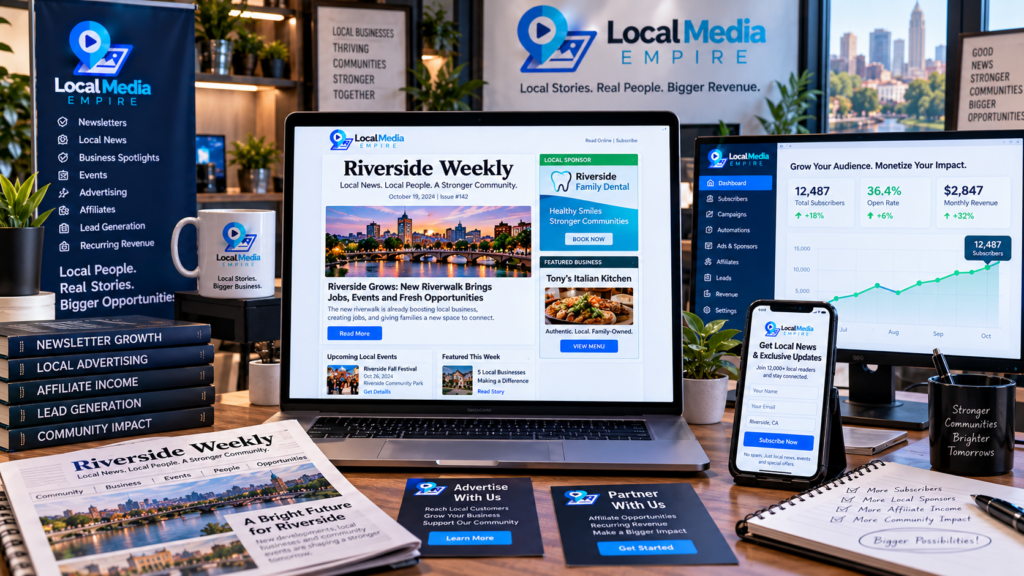
You can sell local advertising on a website by building a clearly defined local audience, creating advertising packages around that audience, approaching relevant businesses directly, and giving advertisers simple ways to purchase and manage their campaigns. Local Media Empire is designed to support this model with local media publishing, newsletter capabilities, audience management, and dedicated local advertising functionality.
The key is to stop selling “banner space” and start selling access to a relevant local audience. A local business is more interested in reaching potential customers in its service area than simply seeing its logo appear on a website.
What Is Local Website Advertising?
Local website advertising is the process of selling promotional placements on a website to businesses that want to reach people in a particular geographic market.
Those placements can include website banners, newsletter advertisements, sponsored positions, promotional features, or other advertising opportunities connected to the publication.
For a local media website, advertising can become one of several revenue streams alongside sponsorships, affiliate promotions, lead generation, directories, and services.
How Do You Start Selling Local Advertising?
Build a focused local audience first, package your available advertising placements, identify businesses that serve that audience, contact them with a clear offer, and make buying and renewing advertising easy.
1. Define Your Local Audience
Before approaching advertisers, be clear about who your website reaches.
Define your:
- City or geographic area
- Primary audience
- Content categories
- Typical visitor interests
- Newsletter audience, if applicable
A focused local publication can make its advertising proposition much easier to understand. A business should be able to quickly determine whether your audience overlaps with the customers it wants to reach.
2. Create Advertising Packages
Don’t make potential advertisers figure out what they can buy.
Create straightforward packages that explain the placement, duration, and promotional opportunity.
For example, you might structure packages around:
- Website banner placement
- Newsletter advertising
- Multiple website placements
- Combined website and newsletter exposure
- Longer-term advertising campaigns
The exact packages should reflect your publication, audience, available inventory, and business model.
3. Approach Businesses That Fit Your Audience
Start with businesses that naturally serve the people who read your publication.
Potential advertisers can include restaurants, retailers, real estate businesses, professional services, local events, home-service providers, entertainment businesses, and other companies operating in your coverage area.
Instead of sending a generic message to hundreds of businesses, make the pitch relevant to each business. Explain who your publication serves and why its customers are likely to be part of your audience.
4. Sell the Audience, Not Just the Ad Space
A common mistake is saying, “I have a banner available.”
A stronger proposition explains what the advertiser gets access to: a specific local audience interested in the community, businesses, events, services, and information covered by the publication.
Your advertising pitch should answer three basic questions:
- Who will see the advertisement?
- Where will the advertisement appear?
- What makes this audience relevant to the advertiser?
5. Add Newsletter Advertising
Your website isn’t necessarily your only advertising inventory.
If you’re building a local newsletter, you can create advertising opportunities inside your email editions as well.
This gives businesses another way to reach your audience and gives you an additional advertising product to sell.
A combined website-and-newsletter package can also make your advertising proposition more substantial than selling a single website placement.
6. Make Advertising Easy to Manage
As the number of advertisers increases, manual administration can quickly become a problem.
Advertising tools that support scheduling, multiple placements, automatic rotation, billing, invoices, advertiser accounts, and self-service management can reduce the administrative workload involved in running a local advertising operation.
How Local Media Empire Helps With Local Advertising
Local Media Empire includes a dedicated Local Advertiser upgrade designed around selling and managing local advertising.
The upgrade includes three banner sizes, multiple website placements, newsletter email banners, ad scheduling, automatic rotation, built-in billing, invoices, advertiser accounts, self-service ad management, and an automatic advertising sales page.
This is useful because the advertising process becomes part of the broader local media platform rather than something you have to manage separately.
You can see how the advertising capabilities fit into the larger platform in the Local Media Empire review.
How Do You Find Your First Local Advertisers?
Start with businesses you already know are relevant to your audience.
Build a simple prospect list based on the categories your publication covers. Then contact businesses with a concise explanation of your publication, audience, advertising opportunities, and campaign structure.
You can also use your existing relationships. A business that has already contributed information, sponsored an event, or engaged with your publication may be more familiar with the value of reaching your audience.
What Should You Include in a Local Advertising Pitch?
A good pitch doesn’t need to be complicated.
Explain:
- What your publication is
- Which local market you cover
- Who your audience is
- What advertising placements are available
- How long campaigns run
- How the business can get started
Keep the emphasis on relevance and the advertising opportunity rather than making unsupported promises about results.
How Can You Increase Local Advertising Revenue?
Once you have advertisers, focus on creating a repeatable system.
Offer multiple campaign options, make renewals simple, maintain consistent communication with advertisers, and continue growing the local audience.
You can also expand beyond website banners by adding newsletter placements, directory listings, sponsored opportunities, and other products that make sense for your publication.
Final Thoughts
Selling local advertising on a website becomes much easier when you build a focused audience first and package access to that audience into clear advertising products.
Build the local publication, grow the website and newsletter together, identify businesses that serve your audience, create simple packages, and make the buying process easy to manage.
The opportunity becomes even more interesting when advertising is combined with other local-media revenue streams instead of being treated as the only source of income.
If you want to see how local content, a media website, newsletter publishing, audience management, and advertising tools can work together, read the full Local Media Empire review.