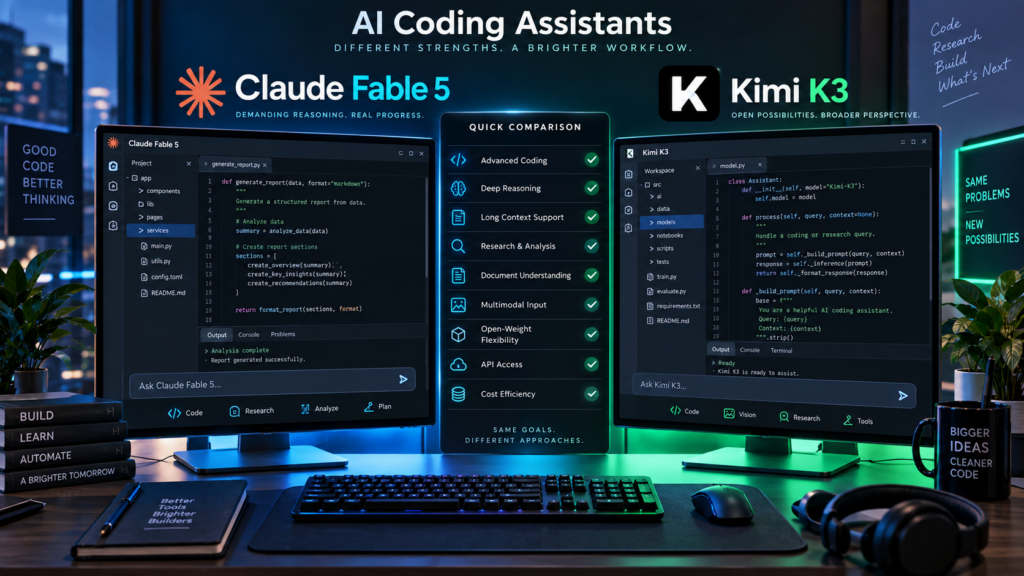
For coding, Claude Fable 5.1 is the better choice when you are tackling large, long-running coding projects, while Kimi K3 is the better fit if you prioritize open-weight access, native vision and developer flexibility. Fable 5.1 is specifically positioned for ambitious coding projects spanning entire codebases, code review, performance work and multi-day autonomous sessions; Kimi K3 is built for long-horizon coding with a 1-million-token context window and native vision. If you want to explore how advanced Claude capability can also be applied to business workflows, you can explore Fable Fox AI.
The important distinction is not simply which model has more parameters or a bigger context window. For coding, you need to consider autonomous execution, debugging, testing, codebase understanding, visual feedback, model access and the type of development environment you want to build.
Kimi K3 vs Claude Fable 5.1 for Coding
Claude Fable 5.1 has the stronger positioning for demanding professional coding and long-running autonomous software projects. Anthropic describes it as its most capable model for ambitious coding, including features spanning an entire codebase, code review, performance work and multi-day autonomous sessions.
Kimi K3 is also specifically designed for long-horizon coding and end-to-end knowledge work. Kimi describes it as a 2.8-trillion-parameter open model with native vision and a 1-million-token context window.
| Coding Factor | Claude Fable 5.1 | Kimi K3 |
|---|---|---|
| Coding focus | Ambitious, long-running coding projects | Long-horizon coding and agentic development |
| Context window | 1M tokens | 1M tokens |
| Vision | Yes | Native vision |
| Model access | Proprietary Claude ecosystem | Open-weight model |
| Autonomous workflows | Strong focus | Strong focus |
| Best fit | Complex professional coding | Open-model development and experimentation |
Why Claude Fable 5.1 Stands Out for Coding
Anthropic built Fable 5.1 specifically for coding and knowledge work that can take hours or span multiple stages.
According to Anthropic, Fable 5.1 can work across an entire codebase, perform code reviews, improve performance, operate during multi-day autonomous sessions, write tests to check its work and use vision to compare the resulting interface against the original design.
That makes Fable 5.1 particularly interesting for projects where the goal is not simply “write this function”, but rather “take this substantial software task from requirements through implementation and testing.”
Why Kimi K3 Is Interesting for Developers
Kimi K3 takes a different approach. Its biggest differentiator is that it is an open 2.8-trillion-parameter model with native multimodal capabilities.
Kimi says K3 is designed for long-horizon coding, knowledge work and reasoning, while its native vision capabilities allow it to work with images, videos and documents. Its 1-million-token context window is also designed for large projects and extended conversations.
Developers can access K3 through Kimi’s web and application products, Kimi Code and the Kimi API, while Kimi also makes the model weights available for developers who want to explore their own deployments.
Which Is Better for Large Codebases?
Both are designed for large-context coding, but Fable 5.1 has the clearer focus on autonomous professional software development.
Anthropic explicitly describes Fable 5.1 working across entire codebases and handling multi-day autonomous coding sessions. Kimi K3’s 1-million-token context makes it capable of handling substantial project context as well, but its broader proposition emphasizes open frontier intelligence across coding, knowledge work and reasoning.
Which Is Better for Visual Coding?
Kimi K3 has a strong advantage if native multimodal development is central to your workflow. Kimi describes K3 as natively multimodal, allowing it to understand text, images and video together.
Fable 5.1 also uses vision in coding workflows. Anthropic specifically says the model can use vision to evaluate coding outputs against the original design or goal.
Which Is More Suitable for Autonomous Coding?
Fable 5.1 has the stronger documented focus on long-running autonomous coding. Anthropic describes agents that can plan work, use tools, recover when something fails and continue through extended tasks with minimal supervision.
Kimi K3 is also explicitly designed for long-horizon coding and agentic work, so it should not be viewed as simply a conventional coding chatbot. Kimi’s model-selection documentation identifies K3 as its flagship model for long-horizon coding and end-to-end knowledge work.
If you want the broader context around these models, including Opus 5 and the business applications being built around advanced Claude models, read the complete Claude Fable 5 vs Opus 5 vs Kimi K3 comparison.
Watch the discussion: See how the latest AI models are changing what individuals and businesses can build with artificial intelligence.
Explore the Fable Fox AI approach to turning advanced AI into business assets.
What About Coding Cost?
Claude Fable 5.1 is currently priced at $10 per million input tokens and $50 per million output tokens. Anthropic also says its cache-read price is 75% lower than Fable 5, which can reduce costs for repeated-context and highly agentic workloads.
Kimi K3 has its own API pricing and access structure, so developers should compare the actual cost of their workload rather than judging purely from model specifications.
Which Coding AI Should You Use?
Choose Claude Fable 5.1 for large, complex and autonomous coding projects where maximum capability and long-running execution are the priority.
Choose Kimi K3 when open-weight access, native multimodal capability and developer flexibility are major priorities.
If you are building conventional applications and want the broader Claude ecosystem, Fable 5.1 has a particularly strong fit. If you want to experiment with an open model or have more flexibility around deployment and model access, Kimi K3 is worth serious consideration.
Frequently Asked Questions
Is Claude Fable 5.1 better than Kimi K3 for coding?
For demanding professional coding and long-running autonomous software projects, Fable 5.1 has the stronger documented positioning. Kimi K3 is also built specifically for long-horizon coding and offers open-weight flexibility.
Does Kimi K3 have a 1-million-token context window?
Yes. Kimi’s official documentation lists a context window of up to 1 million tokens.
Can Claude Fable 5.1 code across an entire project?
Yes. Anthropic specifically describes Fable 5.1 as capable of coding across entire codebases, performing code reviews, handling performance work and operating in multi-day autonomous coding sessions.
Is Kimi K3 open-weight?
Yes. Kimi describes K3 as an open-weight 2.8-trillion-parameter model and provides access through its products and API, with model weights available for developers.
Final Verdict
For serious, long-running coding projects, Claude Fable 5.1 is the stronger fit. For developers who prioritize open-weight access, native vision and flexibility, Kimi K3 is the more distinctive alternative.
The right choice ultimately depends on your development environment and priorities. Fable 5.1 is designed around autonomous professional coding at the highest end of Anthropic’s generally available lineup, while Kimi K3 brings an open-model approach to long-horizon coding and multimodal development.
If you want to see where these models sit in the wider AI landscape, including Opus 5 and business applications, read the complete Claude Fable 5 vs Opus 5 vs Kimi K3 comparison.