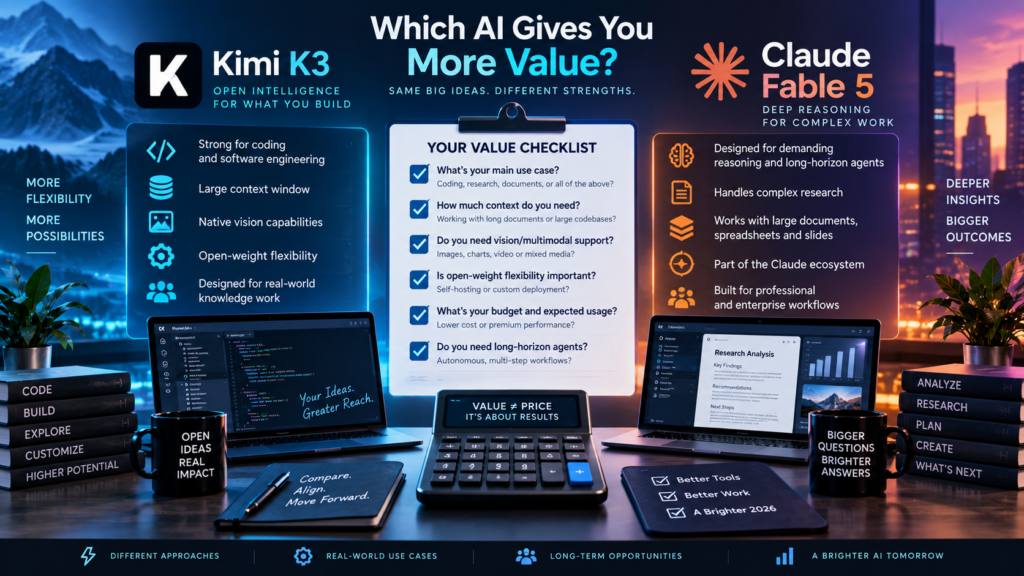
Kimi K3 gives you more for your money if your priority is keeping AI costs down while getting a 1-million-token context window, strong coding and reasoning capabilities, native vision, and open-weight flexibility. Claude Fable 5.1 costs substantially more, but it is specifically designed for demanding reasoning and long-horizon agentic work. If you want to explore how advanced Claude capability can be turned into practical business assets, you can explore Fable Fox AI.
So this comparison is really about two different kinds of value: Kimi K3 emphasizes capability, openness and lower API pricing, while Fable 5.1 emphasizes premium reasoning and sustained agentic performance.
Kimi K3 vs Fable 5.1: The Quick Comparison
| Feature | Kimi K3 | Claude Fable 5.1 |
|---|---|---|
| Context window | 1M tokens | 1M tokens |
| Input price | $3 per million tokens | $10 per million tokens |
| Output price | $15 per million tokens | $50 per million tokens |
| Vision | Native vision | Text and image input |
| Model access | Open-weight | Proprietary |
| Primary positioning | Frontier coding, reasoning and knowledge work | Demanding reasoning and long-horizon agentic work |
Kimi’s current API platform lists K3 at $3 per million input tokens and $15 per million output tokens, with a 1-million-token context window. Anthropic lists Fable 5.1 at $10 per million input tokens and $50 per million output tokens, also with a 1-million-token context window.
Why Kimi K3 Offers Strong Value
Kimi K3 is particularly interesting because you are not giving up the large-context capabilities associated with premium AI models simply to get a lower price.
Kimi describes K3 as its most capable flagship model, built for frontier scenarios including software engineering, knowledge work and deep reasoning. The model also supports native vision and a 1-million-token context window.
The open-weight approach adds another dimension. Developers who value flexibility and experimentation have a different set of options with K3 than they do with a proprietary model such as Claude Fable 5.1.
Why Fable 5.1 Costs More
Fable 5.1 is not simply a more expensive version of a general-purpose chatbot. Anthropic positions it specifically for demanding reasoning and long-horizon agentic work.
The model has a 1-million-token context window, 128K maximum output, always-on adaptive thinking and a high default effort level. Anthropic highlights long-running agentic coding, multistep research, and complex document, spreadsheet and slide workflows.
Fable 5.1 also has a cache-read price of $0.25 per million tokens, substantially below the standard Fable 5 cache-read price. That can matter for agents that repeatedly work with the same large context.
Does Kimi K3 Actually Give You More for Your Money?
If you measure value primarily by published API cost versus core specifications, Kimi K3 has a clear price advantage. Its published input price is 70% lower than Fable 5.1, while its output price is also 70% lower.
But price alone does not determine value.
If Fable 5.1 completes a complicated agentic task more reliably or with less human supervision, the higher token price could potentially be justified by the workflow savings. That is why developers should evaluate the cost of completing the entire task, not just the price per million tokens.
Which Is Better for Coding?
Kimi K3 is designed for long-horizon coding and software-engineering work, while Fable 5.1 is explicitly positioned for ambitious, long-running agentic coding.
For a developer who values open-weight access and lower API costs, K3 presents a compelling value proposition. For a team building complex autonomous coding workflows where reasoning depth and sustained execution are the primary concerns, Fable 5.1 is the more specialized option.
The right question is therefore not simply which model is “smarter.” It is which model completes your actual coding workload most effectively for the total cost.
Which Gives You More for Business Use?
For straightforward content, analysis, coding and automation, Kimi K3’s lower published pricing can make it attractive for experimentation and higher-volume usage.
Fable 5.1 becomes more interesting when the business workflow involves complex reasoning, large amounts of context and long-running agents.
If you are evaluating these models from a business perspective, the broader Claude Fable 5 vs Opus 5 vs Kimi K3 comparison looks at how the models differ and where Fable Fox AI fits into the larger AI opportunity.
Watch the conversation: Josh and I discuss the AI opportunity developing around Claude Fable 5, Opus 5, Kimi K3 and the new generation of AI-powered business workflows.
Which AI Should You Choose?
Choose Kimi K3 if value means getting substantial AI capability at a significantly lower published API price, together with native vision and open-weight flexibility.
Choose Fable 5.1 if value means paying more for a model specifically designed around demanding reasoning and long-horizon agentic work.
For developers experimenting with AI or running cost-sensitive workloads, K3’s economics are compelling. For organizations where the quality and reliability of complex agentic execution matter more than raw token cost, Fable 5.1 deserves consideration.
Frequently Asked Questions
Is Kimi K3 cheaper than Claude Fable 5.1?
Yes. Kimi’s current API platform lists K3 at $3 per million input tokens and $15 per million output tokens. Anthropic lists Fable 5.1 at $10 and $50 respectively.
Does Kimi K3 have the same context window as Fable 5.1?
Yes. Both models are currently listed with a 1-million-token context window.
Is Kimi K3 open-weight?
Yes. Kimi positions K3 as an open-weight model, giving developers a different level of flexibility from Anthropic’s proprietary Claude models.
Is Fable 5.1 worth the higher price?
It can be when your workload specifically benefits from demanding reasoning and long-horizon agentic execution. For simpler or cost-sensitive workloads, Kimi K3’s lower published pricing may make more economic sense.
Final Verdict: Kimi K3 vs Fable 5.1
If your definition of “more for your money” is maximum capability at a lower published API cost, Kimi K3 wins the value equation. It combines a 1-million-token context window, native vision, frontier-oriented coding and reasoning capabilities, and open-weight access at significantly lower published token prices.
Fable 5.1 is the premium option for users who specifically need its demanding reasoning and long-horizon agentic capabilities. Its higher price makes the most sense when those capabilities translate into better results or less human intervention on complex workloads.
For the complete comparison of Fable, Opus, Kimi K3 and the broader business opportunity surrounding these models, read the complete Claude Fable 5 vs Opus 5 vs Kimi K3 guide.