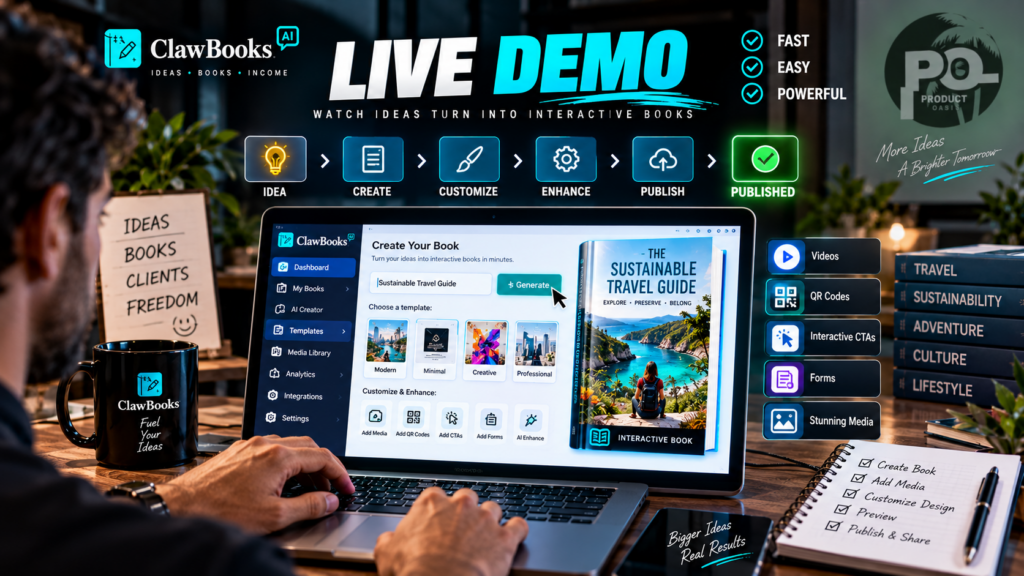
What does the ClawBooks AI publishing workflow actually look like? The easiest way to understand it is to follow the journey from a simple idea or source file to a finished digital publication. ClawBooks AI is built to bring AI creation, publication design, multimedia and publishing into one workflow, and you can explore the ClawBooks AI demo and current offer here.
Instead of starting with a completely blank page and then moving between separate writing, design and publishing applications, the platform is designed around a more direct process: provide an input, generate the publication, customize it, enhance it and publish it.
ClawBooks AI Demo: What Are You Actually Looking At?
A ClawBooks AI demo is most useful when you stop looking at individual features and watch the complete workflow.
The supplied product material describes ClawBooks AI as a cloud-based AI publication platform that can create content from a keyword, URL, PDF or image, as well as from spoken or typed instructions. It can then be used to develop books, publications, magazines, brochures, catalogs, menus and other digital content.
The workflow can be summarized as:
Input → AI Creation → Design → Customization → Interactivity → Publishing
That is the process worth watching in the demo.
Watch the ClawBooks AI Walkthrough
Here is the walkthrough so you can see how the platform is presented and understand the overall publication workflow for yourself.
Explore ClawBooks AI and see the current offer.
Step 1: Start With an Idea, Keyword or Existing Content
The first part of the ClawBooks AI workflow is deliberately flexible.
You do not necessarily have to begin with a finished manuscript.
According to the supplied JV materials, ClawBooks AI can work from:
- Keywords
- URLs
- PDFs
- Images
- Voice input
- Text instructions
This is important because different users already have different starting points.
An author may have a topic.
A marketer may have a URL containing research.
A business may already have a PDF.
A freelancer may receive source material from a client.
An entrepreneur may simply have an idea they want to turn into a publication.
The platform is designed to accommodate those different starting points.
Step 2: Let AI Build the Publication Foundation
Once the source material or instructions are provided, the next stage is AI-assisted creation.
The supplied product material says ClawBooks AI is powered by Claude, ChatGPT, Gemini and other AI models, alongside a self-learning memory component.
This is where the platform moves beyond a traditional design application.
Instead of simply opening a blank canvas, the AI is used to help create the underlying publication.
The objective is to reduce the amount of manual work required to move from an idea to a structured publication.
Step 3: Choose a Publication Format
ClawBooks AI is not restricted to one particular type of document.
The supplied materials describe a range of formats, including:
| Format | Potential Application |
|---|---|
| Books | Digital books and niche publications |
| eBooks | Guides, lead magnets and digital products |
| Magazines | Recurring digital content and publications |
| Brochures | Business and promotional material |
| Catalogs | Products and services |
| Menus | Restaurants and hospitality |
| Interactive Publications | Digital content with multimedia and interactive elements |
This matters because you can use the same general workflow for multiple content objectives instead of having a separate application for every publication type.
Step 4: Start With a Done-for-You Template
Design is often where digital publishing becomes slow.
You may have the content ready but still spend hours deciding how every page should look.
ClawBooks AI addresses this with done-for-you templates. The supplied product material promotes more than 100 templates, while the Template Club upgrade expands the library further.
Templates provide a starting structure for your publication.
Instead of asking:
“How do I design this from scratch?”
You can ask:
“Which template is closest to what I want?”
Then customize it.
Step 5: Customize the Publication
AI should create the foundation—not necessarily dictate the final result.
ClawBooks AI includes a Canva-like drag-and-drop editor that allows users to customize the generated publication.
This is where you can shape the publication around your own:
- Brand
- Colors
- Images
- Headings
- Content
- Layout
- Calls to action
The workflow therefore becomes a combination of AI speed and human control.
Let the AI handle the heavy lifting, then refine the result so it actually represents your brand and audience.
Step 6: Add Images and Multimedia
This is where a basic digital document can become an interactive publication.
The supplied ClawBooks AI materials describe the ability to add videos, GIFs, images, CTAs and other multimedia elements.
Imagine a guide that doesn’t simply explain a process in text.
It could also point the reader toward a supporting video.
Or imagine a product publication where readers can move from information to an action through a clickable CTA.
The publication becomes an experience rather than simply a file.
Step 7: Add QR Codes and Calls to Action
QR codes and clickable CTAs are particularly interesting from a marketing perspective.
A publication can provide information and then give the reader a next step.
For example:
- Scan a QR code to visit a website.
- Click a CTA to access another resource.
- Watch a supporting video.
- Visit a product page.
- Move to another part of a marketing funnel.
This gives your publication a purpose beyond simply being read.
It can become a traffic and engagement asset.
Step 8: Add Lead Capture
For marketers, one of the most useful parts of the ClawBooks AI workflow is lead capture.
The supplied product materials describe lead forms as part of the publication feature set.
This creates a simple marketing concept:
Give people useful information → engage them with the publication → provide a relevant next step → capture the lead.
That makes interactive publications particularly interesting as lead magnets.
A traditional PDF can educate someone.
An interactive publication can potentially educate, engage and direct the reader toward an action.
Step 9: Preview and Refine
This step should never be skipped.
AI can accelerate content creation, but you still want to inspect the finished publication.
Check the:
- Headlines
- Facts
- Formatting
- Images
- Links
- Calls to action
- Branding
- Overall reader experience
The goal is not to publish the first AI-generated version blindly.
The better workflow is:
Generate → Review → Improve → Publish.
Step 10: Publish, Share or Embed
Once the publication is ready, ClawBooks AI provides publishing and distribution options.
The supplied materials describe the ability to publish and embed publications, including public or password-protected options.
This can make the finished publication useful across several environments:
- Websites
- Landing pages
- Resource centers
- Client projects
- Marketing funnels
- Digital product delivery
That is the final stage of the workflow: turning the publication into something your audience can actually access and use.
What Makes the ClawBooks AI Workflow Different?
The key difference is workflow consolidation.
Without a platform like this, you might use one tool to generate text, another to find images, another to design pages, another to create interactive content and another to distribute the finished publication.
Every additional tool introduces another handoff.
Every handoff creates another opportunity for the project to slow down.
ClawBooks AI attempts to bring many of these activities into one publication-focused environment.
That is the real idea behind the demo.
What Can You Create From the Same Workflow?
Consider how many different projects can follow essentially the same process.
| Starting Idea | Possible Finished Asset |
|---|---|
| “Beginner’s guide to SEO” | Interactive SEO guide |
| Existing business PDF | Branded interactive publication |
| Product information | Digital catalog |
| Restaurant information | Digital menu |
| Expert knowledge | eBook or lead magnet |
| Client content | Branded client publication |
| Educational material | Interactive learning resource |
The ability to reuse the same workflow across different formats is one of the reasons ClawBooks AI can appeal to people who publish regularly.
ClawBooks AI Demo for Marketers
If you are a marketer, don’t focus only on the book itself.
Look at what surrounds it.
A publication can be designed as a lead magnet.
It can contain a CTA.
It can incorporate a QR code.
It can contain a lead form.
It can include supporting video or multimedia.
It can be embedded into a website or funnel.
That means the publication can become one component of a larger customer journey.
ClawBooks AI Demo for Freelancers
For freelancers, the interesting question is not simply whether ClawBooks AI can create a book.
The better question is:
Can you turn the workflow into a service?
The supplied product material includes commercial rights with the offer, making client work one of the intended use cases.
That could support services such as:
- eBook creation
- Lead magnet creation
- Interactive guide creation
- Digital brochure creation
- Catalog creation
- Publication formatting and design
For an agency, the White Label upgrade goes further with client accounts, team members, rebranding, custom-domain functionality and client-management features.
ClawBooks AI Demo for Authors and Publishers
Authors and publishers can approach the platform from a different angle.
The goal is volume and consistency.
If you repeatedly create books, guides or other publications, templates and AI-assisted workflows can reduce the amount of repetitive work involved in getting each project started.
The Template Club upgrade is designed for users who want an expanded template library, including additional done-for-you templates and 50,000 done-for-you books with PLR rights according to the supplied materials.
ClawBooks AI Demo and KDP
Publishing to Amazon is another use case mentioned in the upgrade structure.
The Profit Engine upgrade includes KDP-ready export, along with additional publishing and monetization capabilities.
This can be relevant if your publishing strategy includes preparing content for an Amazon KDP workflow.
However, “KDP-ready” should be understood as an export capability rather than a promise of Amazon approval, rankings or sales.
What Should You Look For During the Demo?
When watching a ClawBooks AI walkthrough, focus on these seven questions:
- How quickly can you go from an idea to a publication?
- How much editing control do you have?
- How flexible are the templates?
- Can you add interactive elements?
- Can the publication support lead generation?
- How can the finished publication be distributed?
- Does the workflow match your actual publishing goals?
Those questions are more useful than simply counting the number of features on a sales page.
Is ClawBooks AI Easy to Understand?
At a high level, yes.
The workflow can be reduced to one sentence:
Give ClawBooks AI your idea or source material, let it build the publication, customize the result and publish it.
The additional features then expand what you can do with the publication after it has been created.
That simplicity is important because software can have dozens of features and still be difficult to understand.
ClawBooks AI’s underlying workflow is easier to grasp because every major feature supports the same objective: creating and distributing digital publications.
ClawBooks AI Demo: Is It More Than an AI Book Generator?
Yes.
Calling ClawBooks AI an “AI book generator” captures only part of the picture.
The broader platform includes publication creation, templates, editing, multimedia, interactive elements, lead capture, publishing, embedding and commercial-use functionality.
That makes AI-assisted digital publishing platform a more useful description.
The difference matters because a book generator primarily answers:
“Can I create a book?”
ClawBooks AI attempts to answer a larger set of questions:
“Can I create it, design it, make it interactive, capture leads from it, publish it and potentially create it for clients?”
ClawBooks AI Demo: Final Verdict
The ClawBooks AI publishing workflow is built around a simple but powerful concept: reduce the distance between having an idea and having a finished publication.
You can begin with a keyword, URL, PDF, image, voice or text.
AI helps create the publication foundation.
Templates help establish the visual structure.
The drag-and-drop editor lets you customize the result.
Multimedia makes the publication more interactive.
CTAs and QR codes can direct readers toward the next action.
Lead forms can turn publications into potential lead-generation assets.
Publishing and embedding options help get the finished asset in front of an audience.
And commercial rights make the workflow relevant to client projects as well as personal publishing.
That is the real value of the ClawBooks AI demo.
It is not simply about watching AI write a book.
It is about seeing how multiple stages of digital publishing can be connected into one workflow.
If that is the kind of publishing workflow you have been looking for, the platform is worth exploring.
See the ClawBooks AI Demo and Current Offer
And if you want the broader breakdown of features, pricing, OTOs, bonuses, commercial rights and overall value, read the complete ClawBooks AI review.